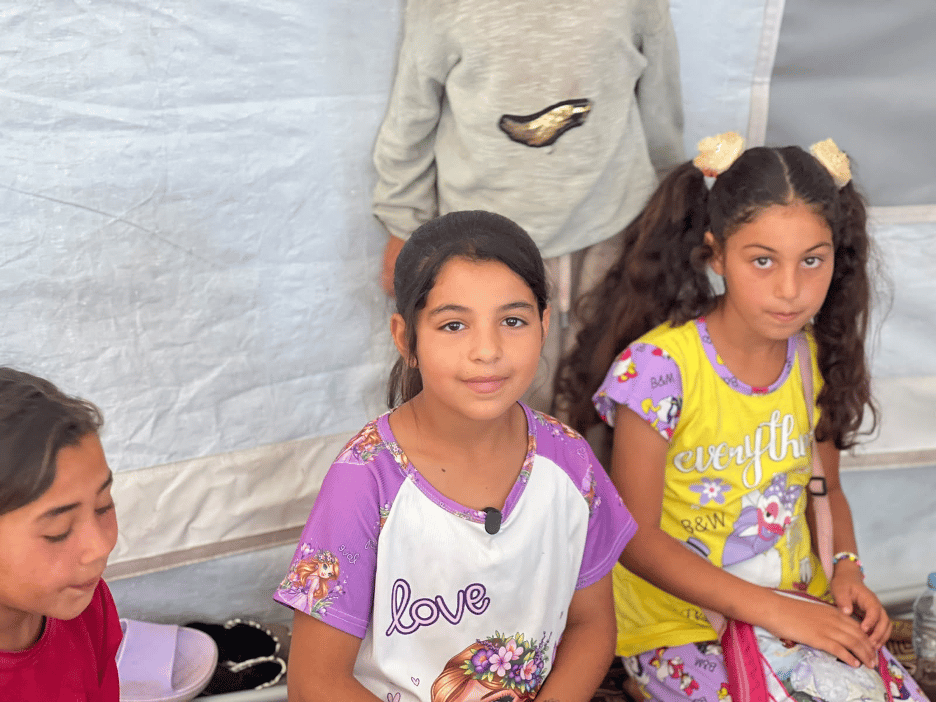
We usually talk about Gaza in statistics. These eight short videos were recorded by our team there so you can hear from the families themselves, in their own words, about what the war has done and how they are getting through it.
A displaced father’s story
Most families in Gaza have been forced from their homes, many more than once. This father was displaced from the Al-Tuffah neighbourhood and now shelters in Deir al-Balah. With no income, he recycles winter blankets into storage bags on a sewing machine he powers with a bicycle wheel in place of a motor, while his young son works beside him because there is no school to go to. Humanity First provides UN-spec tents and emergency supplies to families who have lost their homes.
Snakes, scorpions and rats in the tents
For families in the camps, the tent that shelters them is also a hazard. With no solid walls and no clean ground, rats, snakes and scorpions get in at night, a danger to children as they sleep, on top of the hunger and the heat. This is daily life for hundreds of thousands of displaced people across Gaza, and our teams work in these camps to bring food, health and hygiene support to the families in them.
Burning paper to bake bread
With cooking gas gone and fuel almost impossible to find, families burn whatever they can to cook. This mother fled Beit Lahia in the north when the fighting reached her home, and now shelters with her children in the Rimal neighbourhood, west of Gaza City. Each day she walks the streets gathering scraps of paper and wood, the only fuel she has to bake bread for them. Humanity First distributes food parcels and hot meals to displaced households through the UN Food Security Cluster.
A grandmother, barely surviving
When supplies are scarce, older people are often the last to reach them. This grandmother fled Beit Hanoon with nothing, no mattress or blanket, not even a mat, and now sleeps on bare ground while living with heart disease and high blood pressure. Our dignity kits and hygiene support are meant for people like her, and for people with disabilities, who are easily missed in the rush.
A grandmother raising 19 orphaned children
In one tent, a displaced grandmother from northern Gaza cares for 19 orphaned children, the sons and daughters of the family she has lost. She is the only carer they have left, and she does everything she can to keep them fed and safe. Families like hers, in the hardest-to-reach parts of the north, are the ones our teams there are working to reach with food and essential supplies.
Health and hygiene in northern Gaza
Northern Gaza has been among the hardest areas to reach. In this video our team distributes health packages and adult incontinence products to some of the most vulnerable people in the community, including elderly and sick residents and those caring for them. In overcrowded shelters with broken sanitation, that support is often all that stands between people and an outbreak of disease.
A classroom built from cardboard
With schools destroyed or full of displaced families, most children in Gaza have been out of school since the war began. When their camp had no school and not even a whiteboard, local volunteers built a learning space and gathered nearly 500 students, teaching from a whiteboard made of cardboard and paper covered in tape. Since 2024 Humanity First has run Temporary Learning Sites in southern Gaza, teaching Arabic, English and Maths to more than 2,000 children, coordinated with the UN Education Cluster.
“I just want to learn”
Before the war this young student had a school to go to and friends around her. In this short film she shares one simple wish, for a school uniform and the chance to learn again. Keeping children in lessons is one of the few things that lets them be children while the war goes on.
How you can help
Every family in these videos is still in Gaza, and our team is still with them. Your donation is what keeps that work going.
See how we are responding on our Gaza appeal, or donate to our disaster relief fund to help families like these. You can also explore our longer-term work in Palestine.
Last updated: 26 August 2026